Overview
Stand at the counter in Haleiwa and watch what actually happens when you order. Nobody scoops anything. A solid block of ice goes up into a machine, gets pressed against a blade, and comes off in a soft white drift that piles into the cup like fresh snow. Then the syrup goes on and disappears into it. That is a completely different object from the crushed ice and red syrup cup you remember from a fair back home, and the difference is not marketing. It is physics, and it is the reason people drive an hour across Oahu for a paper cup of flavored ice.
The Short Answer
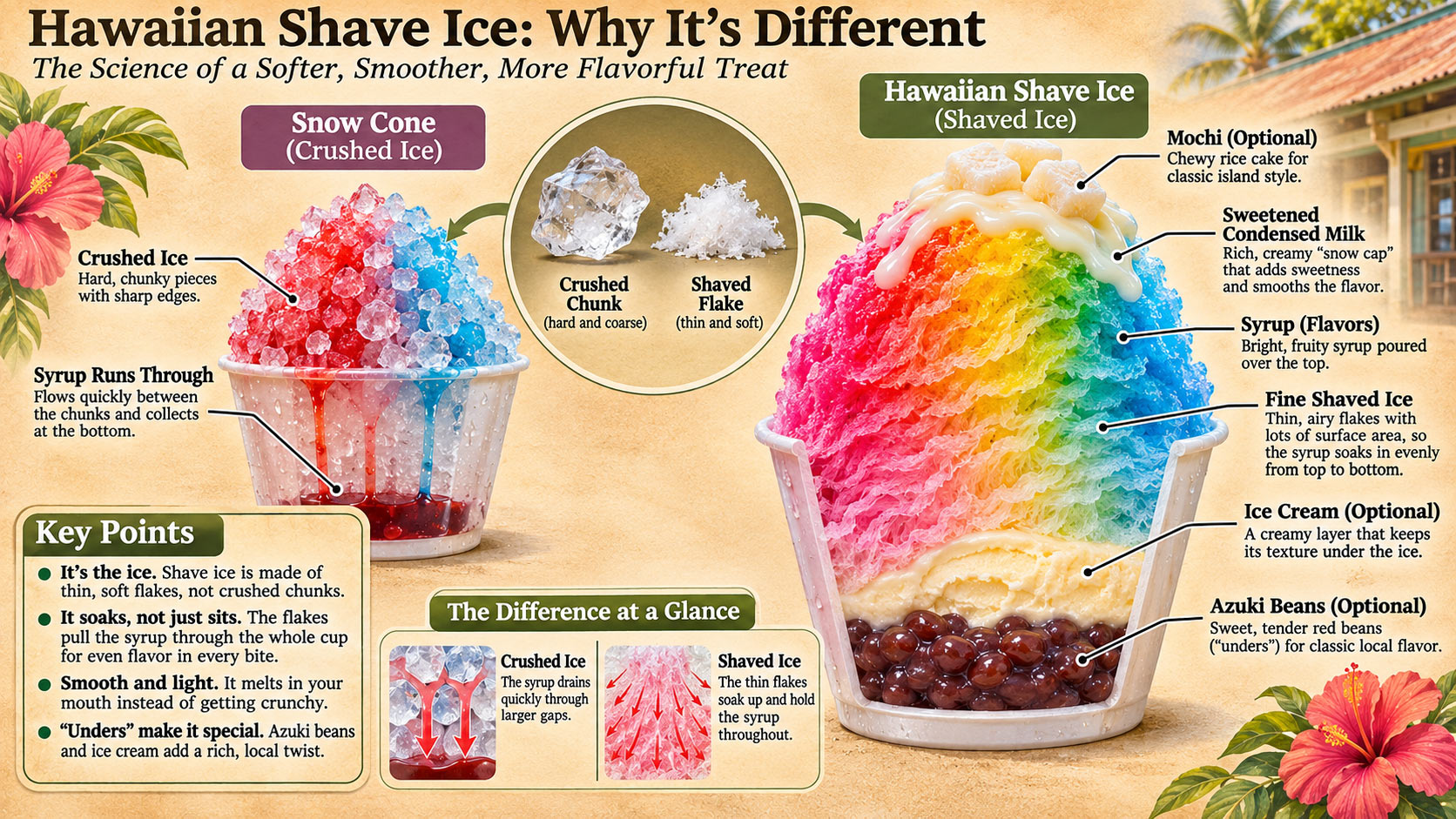
A snow cone is crushed ice. Shave ice is shaved ice.
Crushed ice is made of hard chunks with big gaps between them, so syrup runs straight down and collects in a puddle at the bottom. You get a few sweet bites and then a cup of plain ice.
Shaved ice is a mass of fine, soft flakes with enormous surface area, so syrup soaks through the whole thing and stays there. Every spoonful tastes like the last one. That is the entire trick, and everything else in this post is a consequence of it.
A Dessert Older Than the Plantations
Shave ice did not start in Hawaii, and it is much older than most people assume. It descends from kakigori, a Japanese ice dessert dating back to the Heian period, roughly the 8th to 12th centuries. For most of that history it was a luxury for the wealthy, because the only ice anybody had was collected in winter and kept in insulated ice houses through the warm months. Ice was a status object.
What changed was technology. Through Japan’s Meiji era, machine made ice became cheap and easy to store, and a dessert that had been reserved for the nobility turned into something ordinary people ate.
That is the version that traveled. Around the turn of the last century, as Hawaii’s sugar plantations expanded and recruited heavily across Asia, Japanese immigrant families arrived and brought kakigori with them. They sold it to plantation workers, and the day they sold it says a lot: Sunday, the one day off those workers had. By the 1950s it was a standard item in Japanese owned neighborhood grocery stores across the islands, and through the fifties and sixties business grew again as Californian surfers started showing up on the North Shore.
The name is pure Hawaii. Kakigori became shave ice in Hawaiian Pidgin, which is why it is not “shaved” ice on any sign you will ever see here. In Hawaiian the dessert is haukohi, meaning split or chipped ice. And on Hawaii Island people often flip it around and call the whole thing ice shave instead.
Shaved, Not Crushed
Here is what good shops are actually doing, because it is more involved than it looks.
It starts days before you order. Some shops freeze pure water slowly over several days, stirring it as it goes to keep impurities from settling into the block, because cloudy ice shaves into grit. The water is frozen in molds sized to fit the machine.
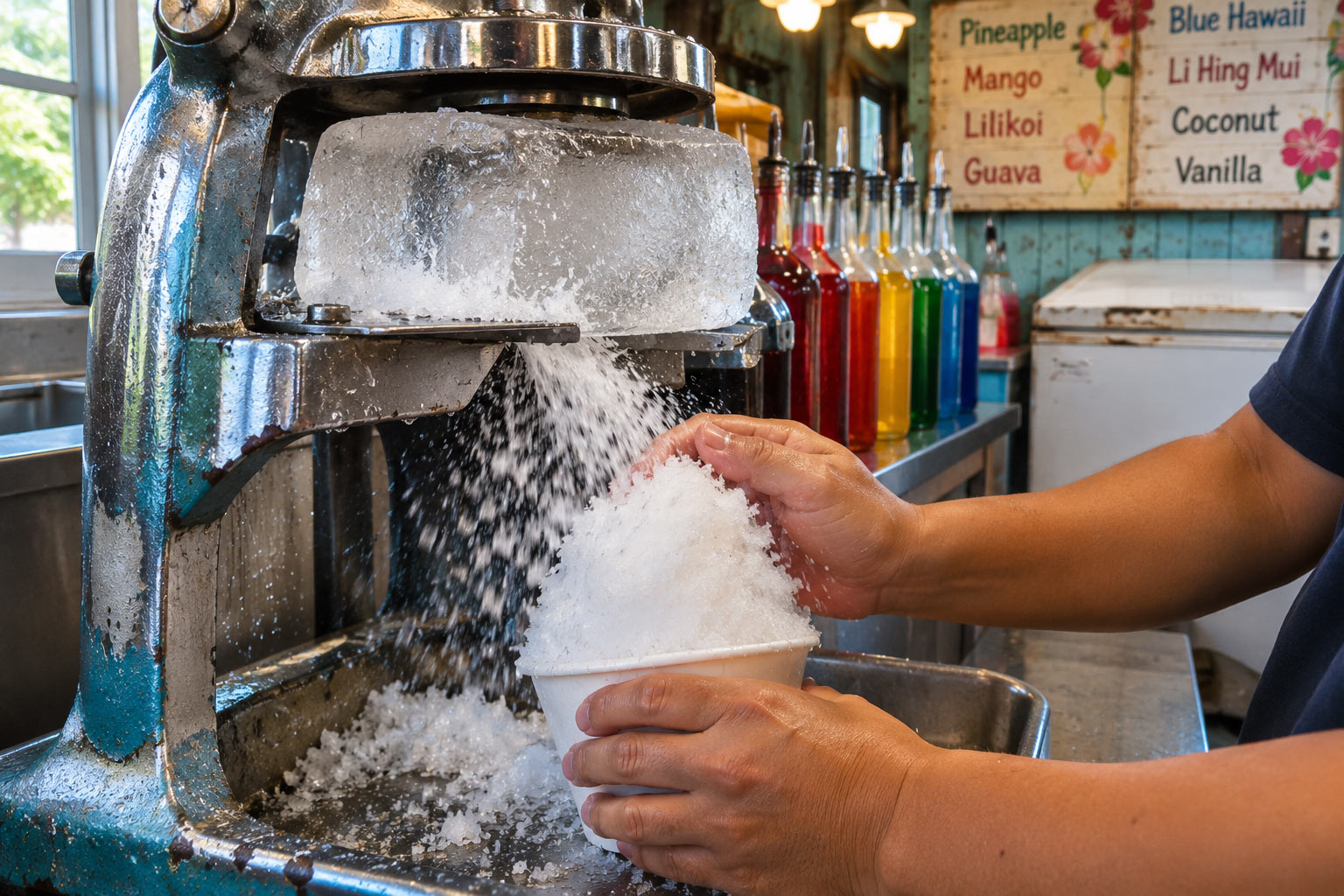
Then comes the step almost nobody notices. The block gets pulled out and left at room temperature for around fifteen minutes before it is used. That tempering is the difference between good and bad shave ice. Too cold and the block shatters into hard little chips that behave like a snow cone. Properly tempered, it releases flakes soft enough to eat with a spoon but firm enough to hold syrup without instantly collapsing. A shop will run the ice somewhere just under 20 degrees for the same reason. The shaving itself is a craft.
- The block rides against a sharp blade, and a good machine is adjusted fine so it never produces chunky flakes
- The operator spins the cup with one hand and shapes the growing mound with the other, which is why a well made one stands up in a dome instead of slumping
- Syrup goes on last, and some shops poke holes down through the ice with a stick so the flavor reaches the bottom rather than sitting on the crown
- Traditionally this was done with machetes against a block. Hand cranked machines are still around. Most shops now run electric
None of that is visible in the finished cup, which is exactly why a lot of visitors assume it is just colored ice.
What to Actually Order
The vocabulary trips people up, so here it is plainly. There are things that go in before the ice and things that go on after, and they are not the same list.
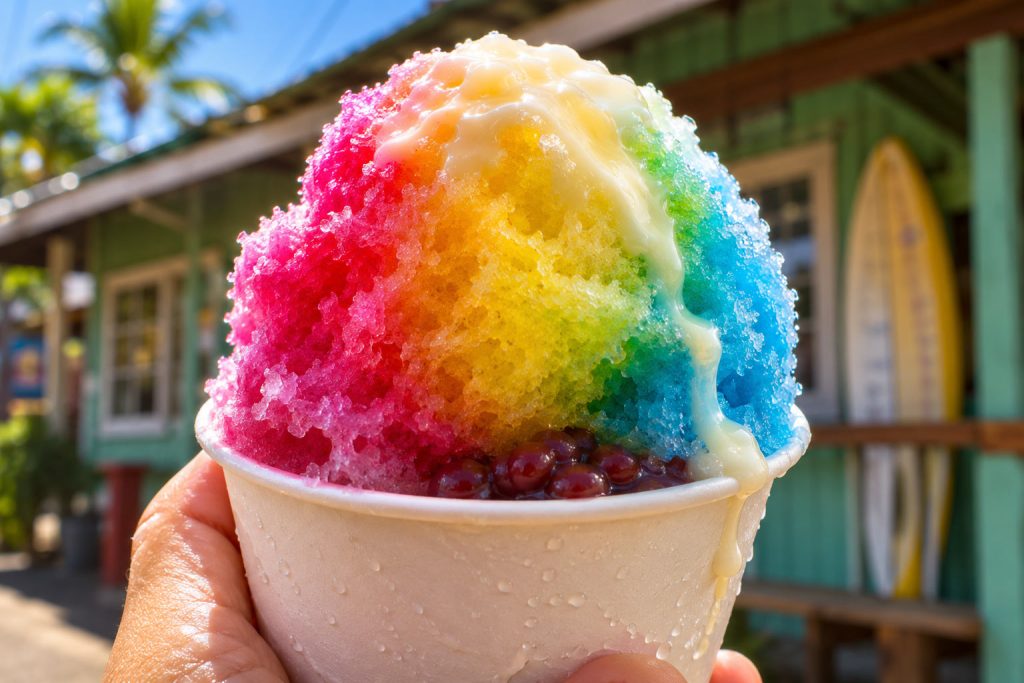
- Unders go in the bottom of the cup first, under the ice. Sweetened azuki beans are the classic, and ice cream or fresh fruit are common
- Toppings go on at the end: mochi balls, li hing mui powder, fresh fruit
- A snow cap is sweetened condensed milk poured over the top. It is the single best upgrade available and the one most first timers skip
Li hing mui deserves a warning and a recommendation at once. It is powdered salty dried Chinese plum, and dusted over sweet fruit syrup it does something sharp and salty and sour all at the same time. Locals love it. Some visitors hate it. Get it on half the cup if you are unsure.
As for rainbow, which is the one everybody orders, it just means stripes of contrasting syrup side by side instead of one flavor over the whole dome. There is no single official combination, whatever anybody tells you. The Hawaiian word for mixing many colors like this is kalakoa, meaning calico. One charming local habit: because certain colors have traditionally gone with certain flavors, such as blue meaning coconut, plenty of regulars order by color and never say the flavor name at all.
If you want to go further down the list, the syrup wall in a real shop runs well past strawberry. Lychee, guava, lilikoi, mango, pickled mango, green tea, coconut cream and a dozen others are all normal.
One last piece of history worth knowing while you eat. Before shave ice was a shop product, plantation camp families made ice cake: condensed milk, syrup and water frozen solid in an aluminum tray and eaten straight, with no shaving involved at all. Same ingredients, no machine, no counter, no line.
Haleiwa Is Where This Became an Institution
Plenty of towns in Hawaii sell shave ice. Haleiwa is the one people make a trip for, and that is a matter of record rather than opinion.
The anchor opened as a grocery store in 1951 and did not start selling shave ice until 1956. It grew alongside the North Shore surfing boom of the 1960s, which brought a steady stream of people down that two lane road with nothing to do after a session but stand around eating something cold. A second family shop opened in 1981 just down the street, and both are still running.
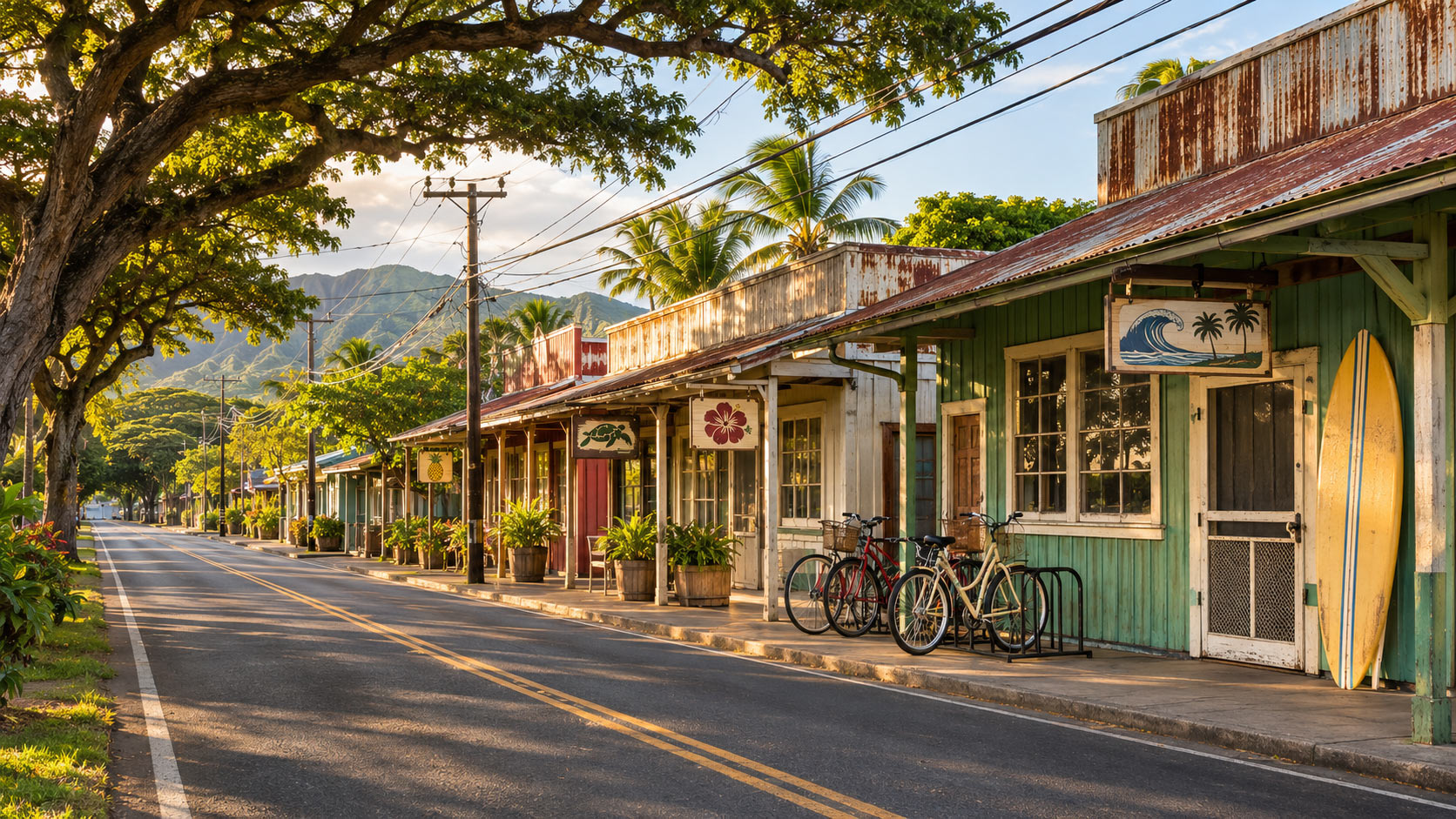
You will find no ranking in this post. Which one is better is an argument that locals enjoy having and that nobody wins, and the honest answer is that both are good and the line length on the day matters more than the brand. What is worth saying is that this is a genuine generational food business in a plantation era town, not a concession stand built for tourists.
Where Shave Ice Lands on a Circle Island Day
On the Oahu circle island food tour, Haleiwa is deliberately last, and shave ice is the reason the ordering works.
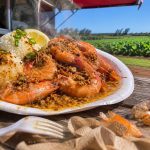
Think about what the day has already done to you by then. Malasadas for breakfast on the southeast shore. Kona coffee and macadamia samples. A Kahuku garlic shrimp plate for lunch, which is rich, buttery and heavy. Tropical fruit and banana lumpia after that. Then the North Shore beaches go past the window, Waimea Bay and the winter surf, and a stop at Puaena Point where green sea turtles sometimes rest on shore, though never on a schedule.
By the time the bus parks in Haleiwa, you have been out since early morning, you are warm, and you are carrying a garlic shrimp plate around with you. A cup of ice is exactly the right last thing. The free time in town is for galleries, shops and the beach, and the shave ice line is part of the stop rather than an errand squeezed into it. A few practical notes from people who have done this with the clock running.
- Get in line first, then browse the shops while you eat. The line is the variable, not the shopping
- Ask for a snow cap. You are here once
- Take the spoon and the straw. You will want both before the bottom of the cup
- Eat it faster than feels dignified. A shave ice in Hawaiian afternoon heat has a short life
A Block of Ice and a Hundred Years
There is something genuinely nice about what this dessert is. A technique for eating ice that started as a luxury for Japanese nobility a thousand years ago got carried across the Pacific by families chasing plantation work, sold for small change on the only day off those workers had, kept alive in corner grocery stores, picked up by surfers, and ended up as the thing a visitor from the other side of the world remembers most clearly about a Tuesday on the North Shore.
Nobody designed that. It just happened, one cup at a time, in a town small enough to walk across in ten minutes. If you want the rest of the island on the same day, the full day circle island tour ends right here, which is the correct place for a day to end. Get the snow cap.